Ask a Master Gardener: Hey! Who Stung Me? Yellowjackets and Other Suspects
Updated: Jul 25
By: Jennifer McDonald, Mobile County Master Gardener ww.mobilecountymastergardeners.org As a gardener and lover of nature, I like to consider myself a friend to all plants and wildlife. However, I definitely prefer keeping “healthy boundaries” with things that try to sting and bite me.
When working outdoors I am most frequently assaulted by ants when I’m careless. I still can’t look my neighbor in the eye after the day I was cheerfully weeding my flowers and suddenly kicked my shoe 50 feet, danced around the yard barefoot and hollerin,’ and then darted inside with one leg already out of my pants.
I’ve dealt with plenty of nature’s harsh elements, but few things trigger more primal panic than realizing you’ve inadvertently declared war on an entire civilization of swarming insects. However, some make better neighbors than others.
Bees are like the friendly family on the corner that always waves. They’d defend their home to the death, if necessary, but they prefer to live in peace. They focus on flowers and working hard to support our food supply, with very little interest in confrontation. They rarely sting unless you trap or step on them. Curious bees will usually leave you alone once they confirm you’re not a flower.
Honeybees are fuzzy and more golden-brown than yellow. They typically make their nests in hollow trees or wall cavities, but they occasionally nest underground or in utility boxes and other structures.
Paper wasps are professional contractors with busy jobs and really nice houses. They are very talented in construction and usually too immersed in home-renovation projects to have time for more than a polite nod. However, they will absolutely cut you if you mess with their custom-designed home.
Paper wasps are lanky with long legs that dangle beneath them when they fly. They build umbrella-shaped paper nests under eaves, porch ceilings, and much more. They look intimidating, but they prefer not to sting unless they are startled or their nest is disturbed. Every time they get me, I swell up like a balloon and feel betrayed by nature herself. “I thought we were friends!”
Hornets are paranoid neighbors that watch through the blinds all day waiting for any sign of trouble. Most times they’ll let you walk on by if you give them enough clearance, but don’t startle them when they’re in a bad mood.
The bald-faced hornets in our area are technically closer to yellowjackets, but they wear little black and white tuxedos instead of yellow and black. They build large, gray, football-shaped nests that usually hang in trees.
Yellowjackets are the volatile neighbors you wish lived a few blocks away. They fly past, glaring, and daring you to try something. They have the emotional regulation of sleepy toddlers, but they carry weapons and occasionally use them for fun.
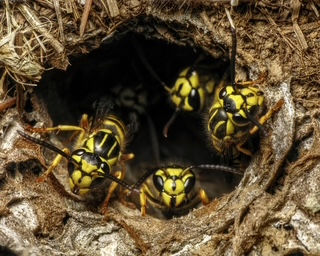
Yellowjackets are small, compact, black-and-yellow wasps. They are usually about a half inch long and have smooth, shiny bodies, unlike the fuzzier honeybee they are often mistaken for. They fly in a unique side-to-side pattern before they land.
Most local yellowjacket colonies reach their largest size by early fall, sometimes containing thousands of workers. Given their aggressive nature a dangerous situation can develop, even without allergies. Since they don’t lose their stingers like honeybees, yellowjackets can sting repeatedly. A single sting can also release a pheromone that allows the rest of the gang to locate you.
Instead of announcing their presence with visible nests, yellowjackets prefer the sneaky approach. They often nest underground in burrows, roots, and utility boxes. Their entrance is often a nickel-sized hole in the ground, which you may not even notice until your lawnmower challenges them to combat. Watch for small stones and dirt piles around the opening of small holes.
Yellowjackets can also nest above ground in places like wall voids, attics, crawlspaces, cement cracks, and tree stumps. You can often find them crashing picnics and trespassing in trash cans, scavenging on food waste. Most of their stings are defensive, perceiving vibrations as attacks on their home. However, they have been known to occasionally attack for no discernable reason.
If you disturb a nest and see them swarming, resist the urge to scream and flail your arms like Mardis Gras. Cover your face and move away as quickly as possible. They can pursue for much longer than you’d like, but they’ll give up when they think you’ve had enough.
They will not be winning any personality contests anytime soon, but yellowjackets do have a valuable role in their local ecosystem, including helping keep other insect populations under control. It’s best to respect their space, but they should be removed or treated if they are found in areas where people or pets hang out.


Comments